SAFETY DATA SHEET
Alkaline Alcohol, 0.2% KOH in 80% Alcohol
1. IDENTIFICATION
Product Identifiers
Product Name:
Alkaline Alcohol, 0.2% KOH in 80% Alcohol
Other Names:
0.2% KOH in 80% Alcohol
Product Number(s):
10382, EMS10382
CAS Number:
Not available
Recommended use of the chemical and restriction on use
Laboratory chemicals commonly used in microscopy, histology, and parasitology.
Company Details
ProSciTech Pty Ltd
11 Carlton Street
KIRWAN QLD 4817
Australia(07) 4773 9444www.proscitech.com
11 Carlton Street
KIRWAN QLD 4817
Australia(07) 4773 9444www.proscitech.com
Emergency Contact Details
ProSciTech Pty Ltd
11 Carlton Street
KIRWAN QLD 4817
Australia(07) 4773 9444www.proscitech.com
11 Carlton Street
KIRWAN QLD 4817
Australia(07) 4773 9444www.proscitech.com
2. HAZARDS IDENTIFICATION
Classification of the substance or mixture
GHS02 Flame
Flam. Liq. 2 H225 Highly flammable liquid and vapour.
GHS08 Health hazard
Carc. 1A H350 May cause cancer.
GHS07
Eye Irrit. 2A H319 Causes serious eye irritation.
Flam. Liq. 2 H225 Highly flammable liquid and vapour.
GHS08 Health hazard
Carc. 1A H350 May cause cancer.
GHS07
Eye Irrit. 2A H319 Causes serious eye irritation.
Label Elements
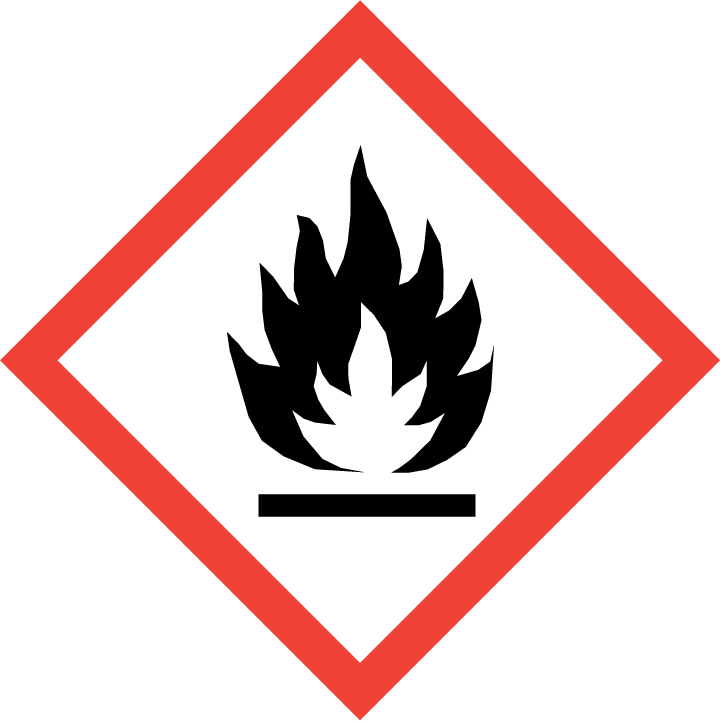
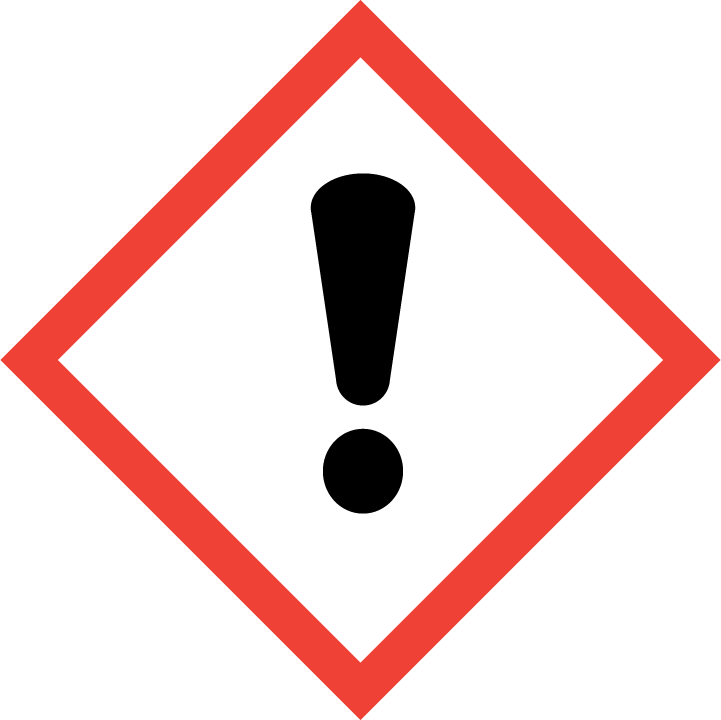
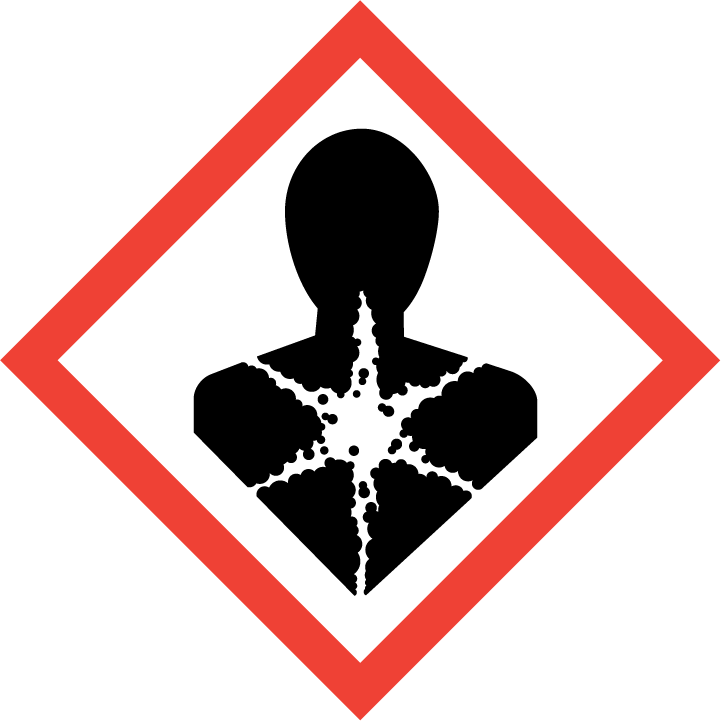
Signal Words
Danger
Hazard Statement(s)
Hazard-determining components of labelling:
Ethyl Alcohol, denatured
Highly flammable liquid and vapour.
Causes serious eye irritation.
May cause cancer.
Ethyl Alcohol, denatured
Highly flammable liquid and vapour.
Causes serious eye irritation.
May cause cancer.
Precautionary Statement(s)
Do not handle until all safety precautions have been read and understood.
Keep away from heat/sparks/open flames/hot surfaces. No smoking.
Keep container tightly closed.
Ground/bond container and receiving equipment.
Keep away from heat/sparks/open flames/hot surfaces. No smoking.
Use explosion-proof electrical/ventilating/lighting equipment.
Take precautionary measures against static discharge.
Wash thoroughly after handling.
Wear protective gloves/protective clothing/eye protection/face protection.
Keep away from heat/sparks/open flames/hot surfaces. No smoking.
Keep container tightly closed.
Ground/bond container and receiving equipment.
Keep away from heat/sparks/open flames/hot surfaces. No smoking.
Use explosion-proof electrical/ventilating/lighting equipment.
Take precautionary measures against static discharge.
Wash thoroughly after handling.
Wear protective gloves/protective clothing/eye protection/face protection.
Primary route(s) of entry
Eye Contact (Highest Risk for Immediate Severe Injury), Skin Contact, Inhalation, Ingestion.
Human Health
Inhalation:
If exposed or concerned: Get medical advice/attention.
Ingestion:
If exposed or concerned: Get medical advice/attention.
Eyes:
Rinse cautiously with water for several minutes. Remove contact lenses, if present and easy to do. Continue rinsing. If eye irritation persists: Get medical advice/attention.
Skin:
(or hair) Remove/take off immediately all contaminated clothing. Rinse skin with water/shower.
Environment
In case of fire: Use for extinction: CO₂, powder or water spray.
Store in a well-ventilated place. Keep cool.
Store locked up.
Dispose of contents/container in accordance with local/regional/national/international regulations.
Store in a well-ventilated place. Keep cool.
Store locked up.
Dispose of contents/container in accordance with local/regional/national/international regulations.
3. COMPOSITION/INFORMATION ON INGREDIENTS
Name
CAS No.
Content (w/w)
Classification
Ethyl Alcohol, denatured
64-17-5
50-100%
Not Available
4. FIRST AID MEASURES
Ingestion
If symptoms persist consult doctor.
Inhalation
Supply fresh air; consult doctor in case of complaints.
Skin Contact
Generally the product does not irritate the skin.
Eye Contact
Rinse opened eye for several minutes under running water. If symptoms persist, consult a doctor.
Other Information
No further relevant information available.
5. FIREFIGHTING MEASURES
Suitable extinguishing equipment
CO₂, powder or water spray. Fight larger fires with water spray or alcohol resistant foam.
HAZCHEM
No further relevant information available.
Special protective equipment and precautions for fire fighters
6. ACCIDENTAL RELEASE MEASURES
Personal precautions, protective equipment and emergency procedures
Wear protective equipment. Keep unprotected persons away.
Environmental precautions
Dilute with plenty of water.
Do not allow to enter sewers/surface or ground water.
Do not allow to enter sewers/surface or ground water.
Methods and materials for containment and clean up
Absorb with liquid-binding material (sand, diatomite, acid binders, universal binders, sawdust).
Dispose contaminated material as waste according to item 13.
Ensure adequate ventilation.
Dispose contaminated material as waste according to item 13.
Ensure adequate ventilation.
7. HANDLING AND STORAGE
Precautions for safe handling
Ensure good ventilation/exhaustion at the workplace.
Open and handle receptacle with care.
Prevent formation of aerosols.
Keep ignition sources away - Do not smoke.
Protect from heat.
Protect against electrostatic charges.
Keep respiratory protective device available.
Open and handle receptacle with care.
Prevent formation of aerosols.
Keep ignition sources away - Do not smoke.
Protect from heat.
Protect against electrostatic charges.
Keep respiratory protective device available.
Conditions for safe storage
Keep container tightly sealed.
Store in cool, dry conditions in well sealed receptacles.
Protect from heat and direct sunlight.
8. EXPOSURE CONTROLS/PERSONAL PROTECTION
Exposure Standards
Material
TWA ppm
TWA mg/m3
STEL ppm
STEL mg/m3
Ethyl Alcohol, denatured
1000ppm
1880mg/m³
Engineering controls
Keep away from foodstuffs, beverages and feed.
Immediately remove all soiled and contaminated clothing.
Wash hands before breaks and at the end of work.
Store protective clothing separately.
Avoid contact with the eyes.
Avoid contact with the eyes and skin.
Immediately remove all soiled and contaminated clothing.
Wash hands before breaks and at the end of work.
Store protective clothing separately.
Avoid contact with the eyes.
Avoid contact with the eyes and skin.
Personal protective equipment
Eye and face protection
Tightly sealed goggles
Skin protection
Protective gloves
The glove material has to be impermeable and resistant to the product/ the substance/ the preparation.
Due to missing tests no recommendation to the glove material can be given for the product/ the preparation/ the chemical mixture.
Selection of the glove material on consideration of the penetration times, rates of diffusion and the degradation
· Material of gloves
The selection of the suitable gloves does not only depend on the material, but also on further marks of quality and varies from manufacturer to manufacturer. As the product is a preparation of several substances, the resistance of the glove material can not be calculated in advance and has therefore to be checked prior to the application.
· Penetration time of glove material
The exact break through time has to be found out by the manufacturer of the protective gloves and has to be observed.
The glove material has to be impermeable and resistant to the product/ the substance/ the preparation.
Due to missing tests no recommendation to the glove material can be given for the product/ the preparation/ the chemical mixture.
Selection of the glove material on consideration of the penetration times, rates of diffusion and the degradation
· Material of gloves
The selection of the suitable gloves does not only depend on the material, but also on further marks of quality and varies from manufacturer to manufacturer. As the product is a preparation of several substances, the resistance of the glove material can not be calculated in advance and has therefore to be checked prior to the application.
· Penetration time of glove material
The exact break through time has to be found out by the manufacturer of the protective gloves and has to be observed.
Body protection
Wear protective clothing.
Respiratory protection
in case of brief exposure or low pollution use respiratory filter device. In case of intensive or longer exposure use self-contained respiratory protective device.
9. PHYSICAL AND CHEMICAL PROPERTIES
General information
Appearance
Clear liquid
Odour
Alcohol-like
pH
Not determined
Vapour Pressure
Not determined
Density
0.83408g/cm³
Boiling Point
78°C
Melting Point
Undetermined
Solubility
Fully miscible
Specific Gravity of Density
Not available
Flash Point
13°C
Flammable (Explosive) Limits
Highly flammable.
Ignition Temperature
425 °C
Formula
Not available
10. STABILITY AND REACTIVITY
Reactivity
No further relevant information available.
Chemical stability
No decomposition if used according to specifications.
Possibility of hazardous reactions
No dangerous reactions known.
Conditions to avoid
No further relevant information available.
Incompatible materials
No further relevant information available.
11. TOXICOLOGICAL INFORMATION
Acute effects
LD/LC50 values relevant for classification:
64-17-5 Ethyl alcohol
Oral LD50 7,060 mg/kg (rat)
Inhalative LC50/4 h 20,000 mg/l (rat)
64-17-5 Ethyl alcohol
Oral LD50 7,060 mg/kg (rat)
Inhalative LC50/4 h 20,000 mg/l (rat)
Eye contact
Causes serious eye irritation.
Skin contact
Based on available data, the classification criteria are not met
Ingestion
Not available.
Inhalation
Based on available data, the classification criteria are not met
Toxicity and irritation
· Germ cell mutagenicity Based on available data, the classification criteria are not met.
· Carcinogenicity May cause cancer.
. Reproductive toxicity Based on available data, the classification criteria are not met.
· STOT-single exposure Based on available data, the classification criteria are not met.
· STOT-repeated exposure Based on available data, the classification criteria are not met.
· Aspiration hazard Based on available data, the classification criteria are not met.
· Carcinogenicity May cause cancer.
. Reproductive toxicity Based on available data, the classification criteria are not met.
· STOT-single exposure Based on available data, the classification criteria are not met.
· STOT-repeated exposure Based on available data, the classification criteria are not met.
· Aspiration hazard Based on available data, the classification criteria are not met.
12. ECOLOGICAL INFORMATION
Ecotoxicity
No further relevant information available.
Persistence and degradability
No further relevant information available.
Bioaccumulative potential
No further relevant information available.
Other adverse effects
Water hazard class 1: slightly hazardous for water.
Do not allow undiluted product or large quantities of it to reach ground water, water course or sewage system.
Do not allow undiluted product or large quantities of it to reach ground water, water course or sewage system.
13. DISPOSAL CONSIDERATIONS
General information
Must not be disposed together with household garbage. Do not allow products to reach sewage system.
Disposal must be made according to official regulations.
Recommended cleansing agents: Water, if necessary together with cleansing agents.
Disposal must be made according to official regulations.
Recommended cleansing agents: Water, if necessary together with cleansing agents.
14. TRANSPORT INFORMATION
ADG label required
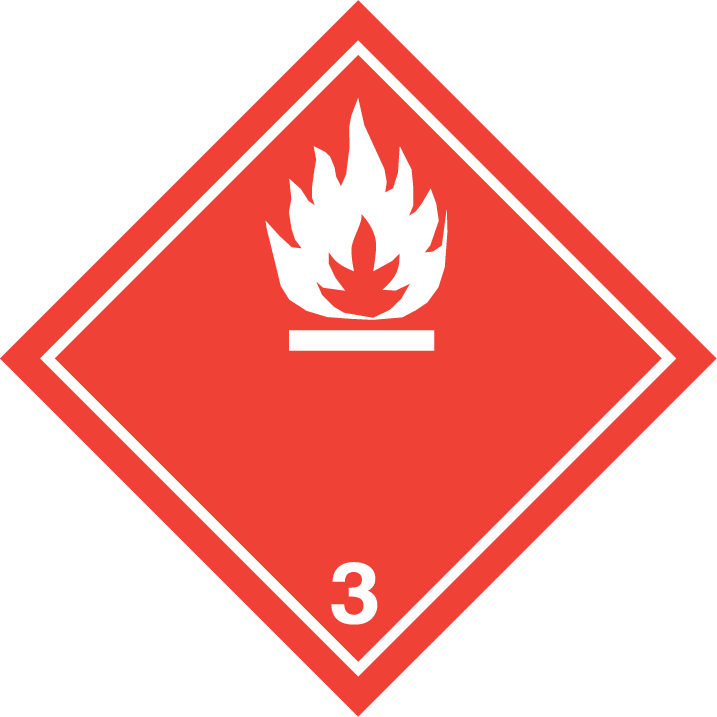
HAZCHEM
No further relevant information available.
UN Number
UN1170
Proper shipping name
· ADG 1170 ETHANOL (ETHYL ALCOHOL)
· IMDG ETHANOL (ETHYL ALCOHOL)
· IATA ETHANOL
· IMDG ETHANOL (ETHYL ALCOHOL)
· IATA ETHANOL
Transport hazard class
Class 3 Flammable liquids. Label 3
Packing group
II
Environmental hazard
Not applicable.
Special precautions for users
Warning: Flammable liquids.
Danger code (Kemler): 33
EMS Number: F-E,S-D
Stowage Category: A
Danger code (Kemler): 33
EMS Number: F-E,S-D
Stowage Category: A
Additional information
ADG
· Limited quantities (LQ) 1L
· Excepted quantities (EQ) Code: E2
Maximum net quantity per inner packaging: 30 mL
Maximum net quantity per outer packaging: 500 mL
· Transport category 2
· Tunnel restriction code D/E
· IMDG
· Limited quantities (LQ) 1L
· Excepted quantities (EQ) Code: E2
Maximum net quantity per inner packaging: 30 mL
Maximum net quantity per outer packaging: 500 mL
· UN "Model Regulation": UN 1170 ETHANOL (ETHYL ALCOHOL), 3, II
· Limited quantities (LQ) 1L
· Excepted quantities (EQ) Code: E2
Maximum net quantity per inner packaging: 30 mL
Maximum net quantity per outer packaging: 500 mL
· Transport category 2
· Tunnel restriction code D/E
· IMDG
· Limited quantities (LQ) 1L
· Excepted quantities (EQ) Code: E2
Maximum net quantity per inner packaging: 30 mL
Maximum net quantity per outer packaging: 500 mL
· UN "Model Regulation": UN 1170 ETHANOL (ETHYL ALCOHOL), 3, II
15. REGULATORY INFORMATION
Poisons Schedule Number
1310-58-3 POTASSIUM HYDROXIDE S5, S6, S10
Other Information
Workers are not allowed to be exposed to the hazardous carcinogenic materials contained in this preparation.
Exceptions can be made by the authorities in certain cases.
A Chemical Safety Assessment has not been carried out.
Exceptions can be made by the authorities in certain cases.
A Chemical Safety Assessment has not been carried out.
16. OTHER INFORMATION
SDS preparation date
20 March 2026
Comments
· Abbreviations and acronyms:
ADR: Accord relatif au transport international des marchandises dangereuses par route (European Agreement Concerning the International
Carriage of Dangerous Goods by Road)
IMDG: International Maritime Code for Dangerous Goods
IATA: International Air Transport Association
EINECS: European Inventory of Existing Commercial Chemical Substances
ELINCS: European List of Notified Chemical Substances
CAS: Chemical Abstracts Service (division of the American Chemical Society)
VOC: Volatile Organic Compounds (USA, EU)
LC50: Lethal concentration, 50 percent
LD50: Lethal dose, 50 percent
PBT: Persistent, Bioaccumulative and Toxic
SVHC: Substances of Very High Concern
vPvB: very Persistent and very Bioaccumulative
Flammable liquids - Category 2: Flammable liquids - Category 2
Eye damage/irritation - Category 2A: Serious eye damage/eye irritation - Category 2A
Carcinogenicity - Category 1A: Carcinogenicity - Category 1A
ADR: Accord relatif au transport international des marchandises dangereuses par route (European Agreement Concerning the International
Carriage of Dangerous Goods by Road)
IMDG: International Maritime Code for Dangerous Goods
IATA: International Air Transport Association
EINECS: European Inventory of Existing Commercial Chemical Substances
ELINCS: European List of Notified Chemical Substances
CAS: Chemical Abstracts Service (division of the American Chemical Society)
VOC: Volatile Organic Compounds (USA, EU)
LC50: Lethal concentration, 50 percent
LD50: Lethal dose, 50 percent
PBT: Persistent, Bioaccumulative and Toxic
SVHC: Substances of Very High Concern
vPvB: very Persistent and very Bioaccumulative
Flammable liquids - Category 2: Flammable liquids - Category 2
Eye damage/irritation - Category 2A: Serious eye damage/eye irritation - Category 2A
Carcinogenicity - Category 1A: Carcinogenicity - Category 1A
References
EMS SDS 0.2% KOH in 80% Alcohol 16/01/2025 https://www.emsdiasum.com/docs/technical/msds/10382.pdf.
This Safety Data Sheet (SDS) has been prepared in compliance with the Preparation of Safety Data Sheets for Hazardous Chemicals Code of Practice February 2016. It is the user's responsibility to determine the suitability of this information for adoption of necessary safety precautions. The information published in this SDS has been compiled from the publications listed in Section 16: to the best of our ability and knowledge these publications are considered accurate. We reserve the right to revise Safety Data Sheets as new information becomes available. Copies may be made for non-profit use.